
 Tidy and home
Raising responsible kids: 7 habits that build it day by day
Responsibility grows from small, repeated habits. 7 ways to raise responsible kids at home, a life skills checklist by age and the research behind each habit.
 The Kidventures team
In short
Responsible kids are made through practice: real jobs at home, the chance to make small mistakes, choices with clear limits, and adults who step back gradually. Give children ownership of tasks they can handle, let natural consequences teach where it is safe, and praise effort and follow-through.

Try this week with your kids
Noki suggests a first week of quests and rewards for your kids. You change what you like before you start.
On this page
Responsibility is one of those qualities every parent wants for their child and nobody can install directly. You cannot lecture a child into being responsible. You can, though, create hundreds of small chances to practice it, and that is how it grows.
Here are 7 habits that make a real difference, with examples for different ages.
What responsibility actually means
For a child, responsibility comes down to a few concrete skills: remembering what needs doing, doing it without being chased, finishing it, and owning the result, good or bad. These rely on what psychologists call executive function, the mental skills of planning, focusing, remembering instructions and juggling several tasks. Harvard's Center on the Developing Child describes these skills as developing through practice and support throughout childhood and adolescence (Center on the Developing Child).
That is why responsibility is built at home, through daily routines, far more than it is taught in conversations.
1. Give them real jobs
Children know the difference between pretend help and real help. A real job is one the family would notice if it were not done: setting the table, feeding the cat, taking out the recycling. Real jobs carry real responsibility.
A large US study that followed almost 10,000 children found that kids who did chores regularly in kindergarten reported stronger feelings of competence in third grade than kids who rarely did chores (White, DeBoer and Scharf, 2019). The study shows an association, so it does not prove that chores cause the difference. Start with our list of chores by age to find a fitting first job, then put it on a chart with the chore chart maker.
2. Hand over ownership, gradually
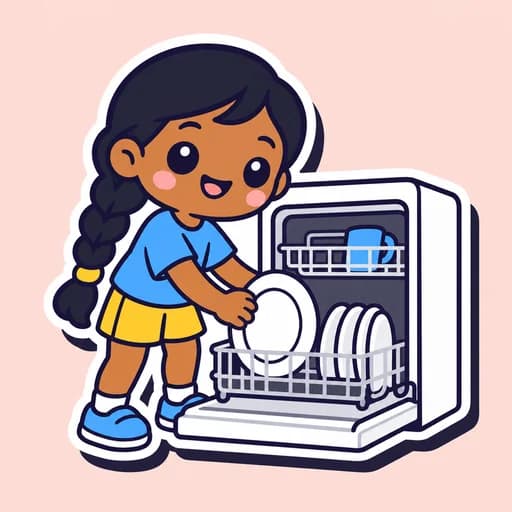
There is a big difference between "help me with the dishes" and "the dishwasher is your job". The first keeps you in charge. The second transfers it.
Move step by step. Do the job together, then let your child lead, then let them do it alone with a quick check, then step away entirely. Psychologists call this kind of support scaffolding: offering as much help as needed and no more. A study of parents and preschoolers found that better scaffolding during a shared task predicted stronger executive function skills later on (Hammond and colleagues, 2012).
3. Let small mistakes happen
It is hard to watch your child forget their swimming kit. It is also the fastest way for them to learn to remember it. Where it is safe and the stakes are low, let natural consequences do the teaching.
The key words are safe and low stakes. A forgotten snack, a damp sweater left in the rain, a toy left outside overnight: these teach. Anything involving health, safety or real harm is not a lesson to let happen.
4. Offer choices inside limits
Responsible people make decisions. Children get better at decisions by making them. Offer real choices inside clear limits:
- "Do you want to tidy your room before or after lunch?"
- "Which 2 jobs do you want this week?"
- "Will you do your reading at the kitchen table or on the sofa?"
The limit is fixed (the room gets tidied), the choice is theirs. Choice increases buy-in and practices decision making at the same time.
5. Keep routines predictable
Routines are a responsibility training ground. When the same jobs happen at the same time each day, children can anticipate them and eventually manage them alone. Research on family routines links regular, predictable routines with children's healthy development and self-regulation (Spagnola and Fiese, 2007).
Our guides to morning routines and bedtime routines show how to set one up step by step, and the routine chart maker turns the steps into a picture chart.
6. Praise the effort and the follow-through
What you praise is what you get more of. Praise for being clever or naturally good at something can make children avoid challenges. In a well-known series of experiments, children praised for intelligence chose easier tasks and did worse after a setback than children praised for effort (Mueller and Dweck, 1998).
So praise the behavior you want to see: "You remembered your library book all by yourself." "You kept going on that puzzle even when it was tricky." Responsibility is mostly follow-through, so notice it when it happens.
7. Model it out loud
Children copy what they see. Let them see you being responsible, and narrate it: "I said I'd call Grandma back, so I'm doing it now." "I forgot to buy milk. I'll write it on the list so I remember." Showing that adults also forget, and how they fix it, is a powerful lesson.
Responsibility by age: what to expect
| Age | Responsible for |
|---|---|
| 2 to 3 | Toys in the basket, cup to the counter |
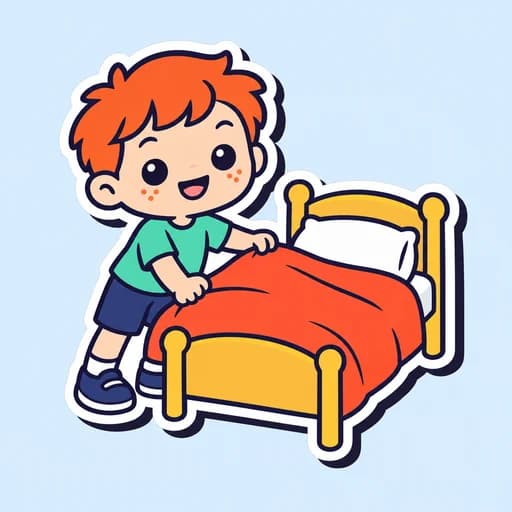
| 4 to 5 | Making the bed, setting napkins, getting dressed |
| 6 to 7 | Packing their school bag, clearing the table |
| 8 to 10 | Homework planner, unloading the dishwasher, pet feeding |
| 11 to 12 | Own laundry, a simple meal with supervision |
| 13 and up | Whole areas of the house, their own schedule |
Our chores by age pages list fitting jobs for each stage.
Life skills checklist by age
Use this as a guide to what children can learn with practice. Tick what your child can do alone and pick the next 1 to teach.
Ages 4 to 6
- Get dressed alone, with clothes laid out
- Wash hands and brush teeth without help
- Carry their plate and set their own place
- Say their full name and their parents' names
Ages 7 to 9
- Tie their shoelaces
- Pack their school bag from a list
- Make a simple snack
- Know their address and a phone number
Ages 10 to 12
- Make their own breakfast
- Plan their homework week
- Count their pocket money and check change in a shop
- Run a load of laundry with a quick check
13 and up
- Cook a simple family meal
- Shop from a list on a budget
- Book an appointment by phone
- Manage their own schedule and alarm
The long game
A famous long-term study followed 1,000 children from birth to age 32 and found that childhood self-control predicted adult health, wealth and wellbeing (Moffitt and colleagues, 2011). Responsibility and self-control are close cousins, and both grow from daily practice in ordinary moments.
You do not need a grand plan. A real job, a little more ownership each month, and patience with the inevitable mistakes will get you a long way. Kidventures helps by making jobs visible to kids so they can track them themselves. Find more ideas in our chore library.
Questions parents ask
At what age can children take responsibility?
Responsibility starts small. A 2 year old can be responsible for putting toys in a basket, a 7 year old for packing their school bag, a 12 year old for their own laundry. The scope grows with age and practice.
How do I stop doing everything for my kids?
Pick 1 thing you do for them every day that they could do themselves, teach it properly, and hand it over. Accept that it will be done less well at first. Repeat with the next task every few weeks.
Are natural consequences a good idea?
Often, when they are safe and proportionate. Forgetting a snack once teaches more than any reminder. Never use natural consequences where health or safety is at stake.
What life skills should a 10 year old have?
Many 10 year olds can make a simple breakfast, pack their own bag, use a homework planner, count change, know their address and a parent phone number, and put away their own laundry. Use it as a guide, since skills depend on practice more than age.
Sources
- Center on the Developing Child, Harvard University. A guide to executive function.
- White, E. M., DeBoer, M. D., and Scharf, R. J. (2019). Associations between household chores and childhood self-competency. Journal of Developmental and Behavioral Pediatrics, 40(3).
- Hammond, S. I., and colleagues (2012). The effects of parental scaffolding on preschoolers' executive function. Developmental Psychology, 48(1).
- Spagnola, M., and Fiese, B. H. (2007). Family routines and rituals: a context for development in the lives of young children. Infants and Young Children, 20(4).
- Mueller, C. M., and Dweck, C. S. (1998). Praise for intelligence can undermine children's motivation and performance. Journal of Personality and Social Psychology, 75(1).
- Moffitt, T. E., and colleagues (2011). A gradient of childhood self-control predicts health, wealth, and public safety. Proceedings of the National Academy of Sciences, 108(7).