
 Tidy and home
Age-appropriate chores: a list by age, from 2 to 12 and up
Age-appropriate chores for kids from 2 to 12 and up: a chart by age, how many chores a day, jobs to earn money, tips for ADHD and how to teach a new job.
 The Kidventures team

In short
Most children can start helping at home around age 2 with tiny jobs like putting toys in a basket. By 5 to 7 they can make their bed and set the table, by 8 to 10 they can vacuum and help cook, and by 11 to 12 they can do laundry, unload the dishwasher and clean a bathroom. Start with 1 job, add 1 new task at a time, and praise the effort more than the result.

Try this week with your kids
Noki suggests a first week of quests and rewards for your kids. You change what you like before you start.
On this page
Children are capable of far more around the house than most of us expect, and the earlier they start, the more natural helping feels. The trick is matching the job to the child: too easy and it feels babyish, too hard and it ends in tears (theirs or yours).
This guide gives you a list of chores by age, explains what "done" looks like at each stage, and shows how to teach a new job so it sticks. Use it as a starting point. Every child is different, and a 6 year old who has been setting the table for 2 years will be ahead of a 9 year old who has never tried.
Why chores are worth the effort
Doing a job yourself is often faster, but the research points in a consistent direction. A large US study that followed almost 10,000 children found that kids who did chores regularly in kindergarten reported stronger feelings of competence in third grade, socially and academically, than kids who rarely did chores (White, DeBoer and Scharf, 2019). A smaller Australian study found that children who did more self-care and family-care chores, such as making a meal for themselves or someone else, scored higher on parent-reported working memory and self-control (Tepper, Howell and Bennett, 2022).
These studies show associations, so they do not prove that chores cause those benefits. They do match what most parents see at home: a child who knows how to do real jobs walks a little taller.
There is also fairness: when everyone carries a share, kids learn that a home is something you look after together.
Chores for ages 2 to 3
Toddlers want to help. They will follow you around with a cloth, so give them a real job.
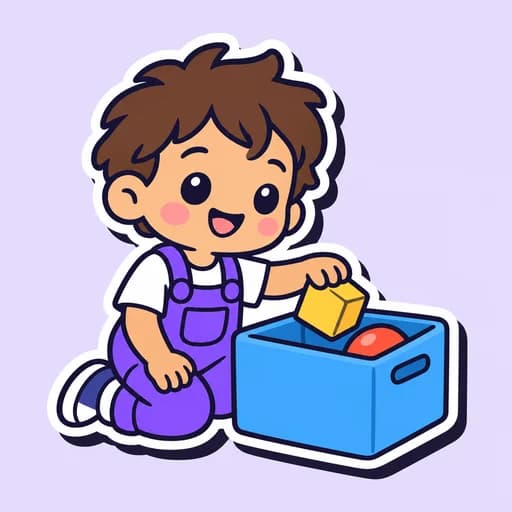
- Put toys in a basket or bin
- Carry their plate or cup to the counter (plastic is fine)
- Put dirty clothes in the laundry basket
- Wipe up small spills with a cloth
- Feed a pet with a pre-measured scoop, with you nearby
- Fetch a diaper, shoes or a book when asked
What "done" looks like: most of the toys end up in the basket. That counts. Your job is to show, do it together, then let them try. For more ideas, read our guide to chores for toddlers.
Chores for ages 4 to 5
Preschoolers can follow a short sequence of steps and love a visual checklist.
- Make their bed (pulling the duvet up is enough)
- Set the table with napkins, cutlery and unbreakable plates
- Clear their own place after meals
- Match socks from the clean laundry
- Water plants with a small watering can
- Tidy their bookshelf
- Help put away groceries that go in low cupboards
What "done" looks like: the job is finished without a reminder at least some of the time. A picture chart helps a lot at this age, because most 4 year olds cannot read a list yet. You can find ready-made charts in our printable chore charts.
Chores for ages 6 to 7
The American Academy of Pediatrics lists jobs such as making their own bed, setting and clearing the table, sweeping, tidying toys, sorting laundry, feeding pets, watering plants and emptying wastebaskets as realistic for 5 to 7 year olds (HealthyChildren.org, AAP, updated February 2024).
- Make their bed every morning
- Set and clear the whole table
- Empty small bins into the main bin
- Sweep the kitchen floor with a small broom
- Pack their school bag the night before
- Help make their own lunch
- Dust low surfaces
What "done" looks like: they can do the job alone once it has been shown 3 or 4 times, and they start to notice when it needs doing. If bedrooms are a battleground, our guide on getting kids to tidy their room can help.
Chores for ages 8 to 10
By now children can manage jobs with several steps and some judgement. The AAP adds vacuuming, helping cook dinner, making snacks, walking the pet and putting away laundry and groceries at this age.
- Vacuum a room
- Help prepare dinner (washing vegetables, measuring, stirring)
- Make simple snacks
- Walk the dog with a grown-up or older sibling, depending on where you live
- Put away their own clean laundry and the groceries
- Take the bins out on collection day
What "done" looks like: the job is finished to a standard you would happily accept from a guest who offered to help. For kitchen jobs and safety rules by age, see our guide to cooking with kids, and for animals and the garden, our pet and garden chores.
Chores for ages 11 to 12
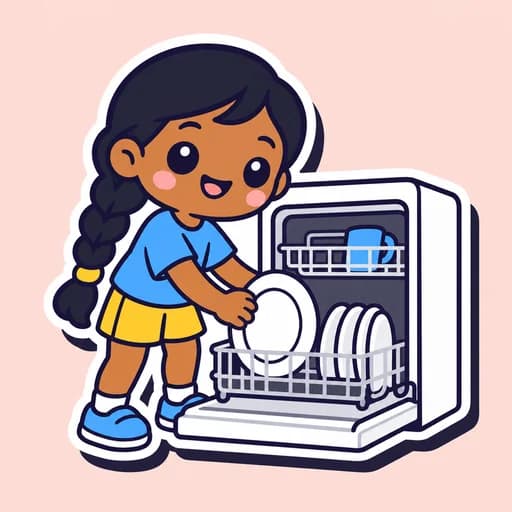
Pre-teens can take over whole areas of responsibility. The AAP list for 11 and 12 year olds includes cleaning the kitchen, changing sheets, unloading the dishwasher, doing laundry, cleaning bathrooms, washing the car and cooking a simple meal with supervision.
- Do a load of laundry from start to finish
- Unload the dishwasher
- Change their bed sheets
- Clean the bathroom sink and mirror
- Cook a simple meal with an adult in the house
- Clean the kitchen after dinner
- Look after a younger sibling for a short time while a parent is home
What "done" looks like: they own the job, including remembering it. Your role shifts from teacher to occasional quality check.
Chores for teens
Teenagers can do almost everything an adult does at home. The challenge is usually motivation and time, since school and friends compete for both. See our guide to chores for teens for ideas that respect their independence.
A quick reference table
| Age | Daily jobs | Weekly jobs |
|---|---|---|
| 2 to 3 | Toys in basket, clothes in hamper | Help feed a pet |
| 4 to 5 | Make bed, set napkins and cutlery | Water plants, match socks |
| 6 to 7 | Clear table, pack school bag | Sweep, empty small bins |
| 8 to 10 | Make snacks, put away groceries | Vacuum a room, take out bins |
| 11 to 12 | Unload dishwasher, clean kitchen | Laundry, change sheets, clean sink |
For a weekly chart you can print and fill in for each age band, see our printable chore charts or the chore chart maker.
How many chores a day?
Start with 1 daily job and add the next only when the first runs without reminders. The AAP advises adding 1 new task at a time for children who are new to chores, because a long list feels overwhelming. As a rough guide, many families settle on 1 or 2 short daily jobs at 4 to 5 and 2 to 4 at school age, plus 1 or 2 weekly jobs. Short and daily beats long and occasional.
Chores for kids to earn money
Many families keep everyday jobs unpaid, because everyone who lives at home helps, and pay only for bonus jobs: washing the car, raking the whole garden, a big clear-out. Agree on the price first and pay on a fixed day; the pocket money calculator helps set the base amount. Our guide to pocket money basics compares the main approaches, and chores for teens covers paid jobs for older kids.
Chores for kids with ADHD
Children with ADHD can do the same jobs as their peers. They usually need more structure around them. The US Centers for Disease Control and Prevention lists tips that fit chores well: keep daily tasks on the same schedule, keep things in the same place, give brief and specific directions, break bigger jobs into small steps and track progress on a chart with realistic goals (CDC, ADHD treatment). In practice, choose short jobs with a clear end, show each step as a picture and praise right away.
How to teach a new chore
A new chore fails most often because it was never really taught. "Tidy your room" is a vague instruction for a 5 year old. Try this 4-step approach instead:
- I do, you watch. Do the job once while describing each step out loud.
- We do it together. Share the job and let your child lead the parts they can manage.
- You do, I watch. Stay close, offer hints, and resist taking over.
- You do it alone. Check in afterwards and name 1 thing that went well.
Keep it going
Consistency matters more than the size of the job. A small task done every day at the same moment builds a stronger habit than a big job done whenever you remember. Link jobs to existing routines: bed after breakfast, bag after homework, toys before bath.
If your family likes visual progress, a chart with stickers or stars can help children see what they have done. Kidventures turns each job into a quest that kids tick off themselves while you approve it from your phone. Browse our chore library for more ideas sorted by age.
Questions parents ask
At what age should kids start doing chores?
Around 2. Toddlers love to copy grown-ups, so tiny jobs such as putting toys in a basket or carrying a napkin to the table work well. The point at that age is the habit of helping, so the result does not need to be perfect.
How many chores should a child do a day?
Start with 1 daily job and add another only when the first one runs on its own. Many families settle on 1 or 2 short daily jobs for preschoolers and 2 to 4 for school-age kids, plus 1 or 2 weekly ones. There is no official number.
Should chores be paid?
Many families keep everyday family jobs unpaid and use pocket money or bonus jobs for extra effort. Both approaches can work if the rules are clear and stay the same from week to week.
What chores can kids do to earn money?
Bonus jobs that go beyond the daily routine work best: washing the car, raking leaves, sorting the recycling for a month, clearing out the garage. Agree on the price before the job starts.
What chores suit a child with ADHD?
Short jobs with a clear end, broken into small steps, at the same time every day. A picture checklist, a timer and quick praise help. The CDC lists routines, clear directions and reward charts among useful parenting tips for ADHD.
Sources
- White, E. M., DeBoer, M. D., and Scharf, R. J. (2019). Associations between household chores and childhood self-competency. Journal of Developmental and Behavioral Pediatrics, 40(3).
- Tepper, D. L., Howell, T. J., and Bennett, P. C. (2022). Executive functions and household chores: does engagement in chores predict children's cognition? Australian Occupational Therapy Journal.
- American Academy of Pediatrics. Chores and responsibility. HealthyChildren.org, updated 2024-02-09.
- Centers for Disease Control and Prevention. Treatment of ADHD. Reviewed 2026-07-30.